
When you talk to parents these days, one thing becomes obvious that nobody is only looking at marks anymore. They want their children to be confident, practical, and able to think for themselves. And to be honest, who can blame them, given how quickly the world is changing? Half the jobs kids will do someday probably don’t even exist yet. What does exist is the need for ideas, curiosity, and the ability to look at something and say – Maybe there’s a better way to do this.
That’s where CBSE schools usually have an advantage. The structure is there, but so is the flexibility. And when schools use that flexibility well, students begin to think beyond “study, write, repeat” and start seeing connections between what they learn and what they experience.
How Schools Can Build an Entrepreneurial Mindset in Students?
1. Letting Students Notice Problems In Their Own Natural Way
A lot of entrepreneurial thinking starts from simple moments like noticing that something is confusing, inconvenient, unfair, or just “not quite right.” When schools encourage students to pause and think about why something works the way it does, it changes their entire approach. Instead of rushing to the answer, they begin to explore the problem.
Half the time, teachers simply need to encourage students to slow down and look around. Kids already have ideas; they just need a place to say them.
2. More Hands-On Learning
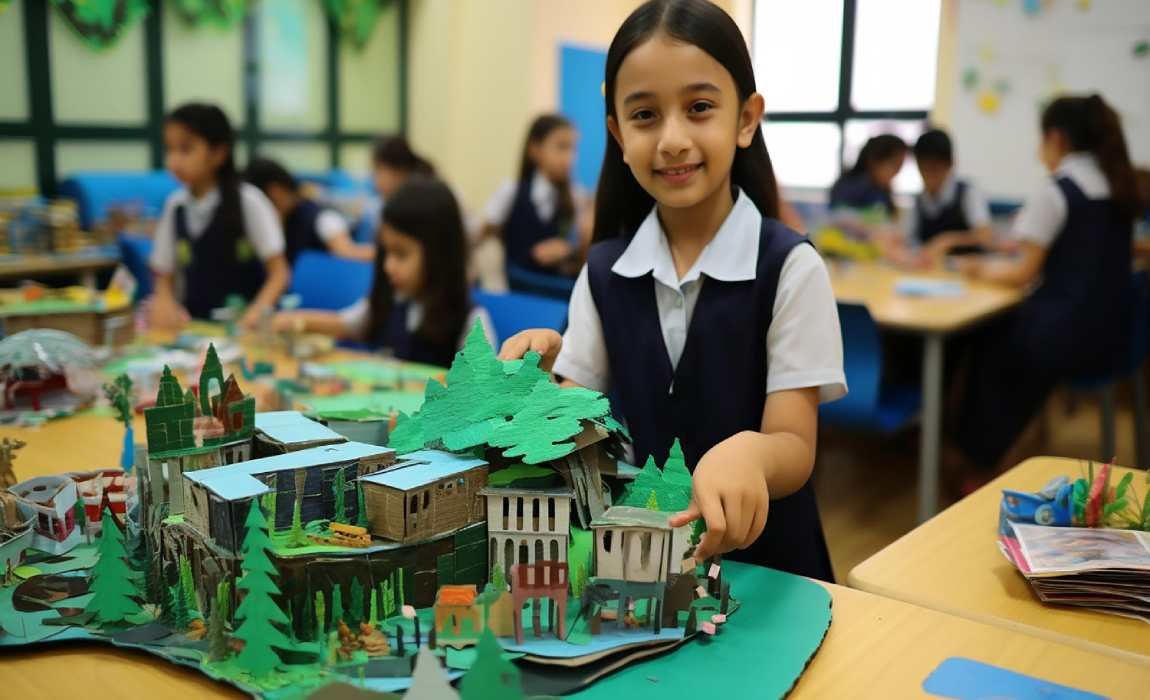
Some of the best learning moments happen when things don’t go right. A model collapses, a robot doesn’t move, a fair project doesn’t sell, and instead of panicking, students learn to rethink and adjust. When students start tinkering, building, painting, and experimenting, they slowly get comfortable with trial and error, which is the heart of innovation.
3. Integrating Modern Skills into the Curriculum
These days, students might learn basic coding, simple budgeting, how to present ideas, or how to research properly. But the best part is that when schools introduce these things casually as part of regular activities, kids absorb them without pressure.
A student who knows how to calculate a basic cost sheet at age 13 might not think much of it. But years later, it becomes second nature. That’s how entrepreneurial confidence builds quietly, bit by bit.
Also Read: Why Choose a CBSE School for Your Child’s Education?
4. Creating a Supportive Environment for Ideas
Most of the time, what really blocks creativity is plain old fear – the fear of saying something that sounds weird, the fear of being wrong, or the fear that people might laugh. And honestly, once that fear drops even a little, ideas start coming out without so much effort.
In schools that truly push kids to think differently, no one is obsessed with getting everything right. Curiosity matters more than perfection. Even a small attempt gets appreciated. Teachers give students the comfort to say, “I’m not very sure, but this is what I feel,” without worrying how it’ll sound.
And the funny thing is, you don’t always need some big system to make this happen. A simple suggestion box, a wall where kids can pin their ideas, or just a weekly open chat can change the whole vibe of the classroom. Suddenly, students feel more relaxed and open to sharing whatever is on their mind.
5. Bringing Real Stories Into The Classroom
Kids get inspired when they see real people doing real things, not just stories printed in a textbook. Meeting someone who’s built a small business, solved a simple neighbourhood problem, or created something just out of curiosity hits differently. It sticks with you because it feels genuine and possible.
When schools bring in such people for talks, organize casual workshops, or even take students out to see workplaces, it suddenly connects the dots. Students start thinking, “Oh, so this is how what we study actually works outside the classroom.” It turns learning from something abstract into something they can imagine themselves doing one day.
6. Letting Teamwork Be A Natural Part Of Learning
Entrepreneurship isn’t really a one-person thing. Although anyone may have an amazing idea, bringing it to work requires various people to make it happen. If schools let students group up, they begin to understand the true meaning of teamwork. It’s taking note of others as well as changing their own ideas to a degree, sharing monotonous tasks, and dealing with feedback without judging.
And the best aspect is that it’s actually the things that happen every day that teach kids the most. Clubs, group projects or house-based activities might appear small, but it’s the place where children learn how to deal with various kinds of people, learn how to help each other and even learn to manage when things become messy.
7. Keeping Creativity Alive Outside Academics
There are kids who love drawing and some are unable to stop playing drums on tables, others enjoy making things at home while others get completely absorbed in machines or plants. If schools are aware of and promote these interests instead of ignoring them they begin teaching children how to think differently and approach issues in a creative way.
8. Good Mentors Make All The Difference
Behind every confident child, there’s usually a mentor who encourages them at the right time. A teacher who says, “This is interesting – try this too,” or “Your idea has potential, don’t drop it,” can change everything.
The kind of assistance that mentorship provides stays with students even if they don’t recognise it immediately. Mentorship is among the least known but most powerful factors in shaping the future of innovators.
Also Read: Why Rainbow International School Is Among the Top Schools in Thane
Conclusion
Entrepreneurship doesn’t just pop up after one workshop or a single competition. It grows slowly, day by day, through little experiments, moments of curiosity, teachers who cheer you on, and a school environment that actually lets ideas breathe instead of shutting them down before they even get a chance.
When children study in places where they feel heard and encouraged, they naturally become confident problem-solvers who aren’t scared to try something new.
Many CBSE schools in Thane, including Rainbow International School, are already moving in this direction creating spaces where students don’t just learn but also imagine, question, build, and explore who they can become.
