Nine nights of the Navadurga, the story of Rama and Ravana, trilingual essays and speeches for school, regional traditions from across India, a classroom quiz, and free festive graphics — all in one guide for the Rainbow International School community.
By Rainbow International School, Thane Published 17 September 2026
Rainbow International SchoolNavratri & Dussehra 2026 · 11–20 October
Navratri Begins — Sun, 11 Oct 2026…
Dussehra / Vijayadashami — Tue, 20 Oct 2026…
Chapter I
The Nine Nights Begin
Every October, India slows down just enough to light a diya, tie on a dandiya stick, and remember a story that has been told for thousands of years — one where courage outlasts cruelty, and light always finds its way past the dark. In 2026, Sharad Navratri begins on Sunday, 11 October, and unfolds over nine nights of worship, colour, music, and fasting, before culminating in Dussehra (Vijayadashami) on Tuesday, 20 October — the day Lord Rama's victory over Ravana is celebrated across the country with the spectacular ritual of Ravana Dahan.
Few festival seasons in the Indian calendar carry as much depth or as much celebration in one stretch. Navratri alone honours nine distinct forms of Goddess Durga, each with its own colour, mythology, and meaning; Dussehra adds an entirely different epic — the Ramayana — and a nationwide tradition of burning towering effigies as fireworks light up the sky. Layered on top of this are strikingly different regional expressions: Garba and Dandiya nights in Gujarat, elaborate Durga Puja pandals in Bengal, doll displays called Golu in the South, and dramatic Ramlila performances across the North.
This guide has been put together for the Rainbow International School community — students, parents, and teachers alike — as a single, comprehensive resource for everything Navratri and Dussehra 2026: the mythology and history, day-by-day goddess profiles, trilingual essays and speeches for school use, regional traditions, a fasting guide, activity ideas for the classroom, a quiz, wishes, downloadable social media graphics, and answers to the questions families ask most. Wherever your family's traditions take you this festive season, we hope this guide adds a little more meaning, and a lot more joy, to the celebrations.
The Story Behind Navratri — Durga and the Triumph Over Mahishasura
Long before Navratri became the nine nights of music, colour, and dance that families across India now look forward to, it was a story about a crisis among the gods themselves. According to the Puranic tradition, a powerful demon named Mahishasura had performed intense penance and won a boon that made him virtually invincible — no god or man, he was assured, could ever defeat him. Emboldened by this near-immunity, Mahishasura went on to overrun the heavens, driving out Indra and the other deities from their own realm.
Faced with a threat that no single god could counter, Brahma, Vishnu, and Shiva, along with the other gods, decided that only a power greater than any one of them combined could restore balance. From their combined energies — a blaze of light said to have been more brilliant than a thousand suns rising together — emerged a radiant female form: the Goddess Durga. Each god contributed to her creation, lending her his own distinctive weapon and attribute. Shiva gave her a trident, Vishnu a discus, Indra a thunderbolt, Vayu a bow, Agni a flaming spear, and Himavan, the lord of the mountains, gave her a lion to ride upon. In this telling, Durga is not one god's creation alone, but the shared answer of the entire divine order to a threat that demanded unity.
Thus armed and mounted, Durga rode out to confront Mahishasura, who had the unusual power to shift his form at will — appearing sometimes as a buffalo, sometimes as a lion, an elephant, or a man, testing her at every turn. The battle that followed is traditionally described as having raged for nine days and nights, each day bringing a fresh confrontation as Mahishasura changed shape to evade her. It is this nine-day span of the battle that Navratri ("nine nights") commemorates, with each day dedicated to one of the nine forms of the Goddess — the Navadurga — who together embody the many facets of her strength, compassion, wisdom, and resolve.
On the tenth day, as Mahishasura reverted to his true buffalo form in one final assault, Durga finally struck him down, driving her trident through him and ending his tyranny. This decisive victory is remembered as the origin of Vijayadashami — the "victory on the tenth day" — the same day on which, in the parallel tradition associated with Dussehra, Lord Rama's triumph over Ravana is also celebrated.
What makes this story enduring for families today is not merely its drama, but what it represents. Durga is not depicted as a warrior born of anger alone; she is Shakti — the primordial feminine energy said to underlie all creation, capable of nurturing as readily as she is capable of protecting. Her many arms, each holding a different weapon gifted by a different god, are often read as a symbol of collective strength — the idea that when goodness is fragmented and complacent, evil can grow unchecked, but when it unites, even the most formidable darkness can be overcome. For children growing up with this story, it offers an accessible and powerful idea: courage, compassion, and cooperation, brought together, are more than a match for arrogance and cruelty. It is this timeless message, retold each year through worship, dance, and celebration, that gives Navratri its enduring place in Indian cultural life.
History of Navratri & Dussehra as Festivals
The roots of Navratri and Dussehra reach back a very long way in India's religious and cultural history, though the festivals we recognise today are the product of a gradual evolution rather than a single moment of origin. Scholars generally trace early forms of goddess worship and seasonal harvest festivities to the Vedic and later Puranic periods, when reverence for Shakti — the divine feminine principle — existed alongside worship of other deities. Over subsequent centuries, texts such as the Devi Mahatmya (part of the Markandeya Purana) gave the Durga–Mahishasura narrative its enduring literary form, helping cement the nine-day worship of the Goddess as a distinct devotional practice.
Parallel to this, devotion to Rama grew significantly through the medieval bhakti (devotional) movement, particularly from around the 15th and 16th centuries onward, when poet-saints across the subcontinent composed verses and retellings that brought the Ramayana into everyday devotional life in regional languages, making Rama's story accessible far beyond scholarly or priestly circles. Tulsidas's Awadhi retelling of the Ramayana in North India is widely credited with deeply influencing how Rama's story came to be performed and celebrated in public settings, laying the groundwork for traditions such as Ramlila.
Over time, royal patronage in different parts of India also shaped how these festivals were publicly observed — Navratri celebrations in royal courts of Gujarat, Bengal, and South India, for instance, each developed distinct regional flavours, while Dussehra found grand civic expression in places like Mysuru, where it evolved into a large state celebration under regional rulers. Bengal's Durga Puja likewise grew over centuries from household and community worship into the elaborate public pandal culture recognised today.
By the modern era, these once regionally distinct observances had grown into a shared, pan-India festive season — with local customs, foods, music, and performance styles varying widely from state to state, even as the underlying themes of divine feminine power and the victory of good over evil remained constant threads. Today, Navratri and Dussehra stand among the most widely observed festivals in the Indian calendar, carrying centuries of devotional, literary, and cultural layering within a celebration that still feels immediate and personal to each family that marks it.
Significance of Navratri & Dussehra
At their core, Navratri and Dussehra revolve around one central idea, told through two different stories: that righteousness, however outmatched it may appear, ultimately prevails over arrogance and wrongdoing. Durga's victory over Mahishasura and Rama's victory over Ravana are both, in their own way, meditations on this theme — reminding us that strength without humility, and power without conscience, cannot endure indefinitely.
Navratri, in particular, is also a dedicated celebration of Shakti — the belief that the feminine principle is not passive, but is itself the source of creative and protective energy in the universe. The nine days of the Navadurga honour different aspects of this energy, from fierce protection to gentle nurturing to the pursuit of knowledge, offering a fuller, more layered understanding of strength than aggression alone. For many families, this is also an opportunity to reflect on the women in their own lives and the many roles — caregiver, provider, protector, guide — they hold simultaneously.
The festival period is traditionally also associated with self-reflection and renewal. The fasting observed by many during Navratri is often framed less as a rigid ritual obligation and more as an invitation to pause, simplify one's routine, and turn attention inward. Vijayadashami, meanwhile, has long been considered an auspicious day for new beginnings — starting new ventures, learning new skills, or formally beginning a child's educational journey through Vidyarambha.
For a school community that brings together families of many backgrounds and beliefs, the enduring appeal of this festival season lies precisely in this universality: whichever specific tradition a family follows, the underlying values — courage over fear, humility over arrogance, and light over darkness — are ones that resonate broadly, making Navratri and Dussehra a genuinely shared moment of celebration and reflection across the school community.
Navratri 2026: Key Dates at a Glance
Sun · 11 October 2026
Day 1 — Shailputri (Ghatasthapana)
Colour of the day: Orange.
Mon · 12 October 2026
Day 2 — Brahmacharini
Colour of the day: White.
Tue · 13 October 2026
Day 3 — Chandraghanta
Colour of the day: Red.
Wed · 14 October 2026
Day 4 — Kushmanda
Colour of the day: Royal Blue.
Thu · 15 October 2026
Day 5 — Skandamata
Colour of the day: Yellow.
Fri · 16 October 2026
Day 6 — Katyayani
Colour of the day: Green.
Sat · 17 October 2026
Day 7 — Kalaratri
Colour of the day: Grey.
Sun · 18 October 2026
Day 8 — Mahagauri (Maha Ashtami / Durgashtami)
Colour of the day: Purple.
Mon · 19 October 2026
Day 9 — Siddhidatri (Maha Navami)
Colour of the day: Peacock Green.
Tue · 20 October 2026
Vijayadashami / Dussehra — Ravana Dahan in the evening
The day of victory.
A Note on TimingsExact Ashtami, Navami, and puja muhurat timings can vary slightly depending on region and the local panchang, so families are encouraged to confirm precise timings with their local priest or temple rather than treating any single timing as universal.
Chapter II
Nine Forms, Nine Nights
Each night of Navratri belongs to one of the Navadurga — nine forms of Goddess Durga, each embodying a different strength. Together they trace a journey from grounded resolve to spiritual mastery.
The Nine Forms of Goddess Durga
Day 1 · 11 October
Shailputri
"Daughter of the mountain," seated upon Nandi the bull, holding a trishul and a lotus. She represents the raw, grounded power of nature — the foundational form of Shakti from which her other manifestations arise.
ॐ ऐं ह्रीं क्लीं शैलपुत्र्यै नमः
Om Aim Hreem Kleem Shailaputryai Namah
"Salutations to the daughter of the mountain."
Day 2 · 12 October
Brahmacharini
A serene ascetic in white, holding a japa mala and kamandalu, recalling Parvati's austerities to win Shiva. She symbolises perseverance, self-control, and the rewards of unwavering dedication.
ॐ ऐं ह्रीं क्लीं ब्रह्मचारिण्यै नमः
Om Aim Hreem Kleem Brahmacharinyai Namah
"Salutations to she who practises penance and discipline."
Day 3 · 13 October
Chandraghanta
Recognised by the bell-shaped crescent moon on her forehead, riding a lion with ten arms of weapons. Her form holds beauty and strength together, invoked for courage and calm bravery.
ॐ ऐं ह्रीं क्लीं चन्द्रघण्टायै नमः
Om Aim Hreem Kleem Chandraghantayai Namah
"Salutations to she who bears the crescent moon."
Day 4 · 14 October
Kushmanda
Believed to have created the universe with a divine smile, radiating warmth like the sun. Eight-armed, lotus-bearing, and accompanied by a lion — a symbol of vitality and life-giving energy.
ॐ ऐं ह्रीं क्लीं कूष्माण्डायै नमः
Om Aim Hreem Kleem Kushmandayai Namah
"Salutations to the cosmic creative energy."
Day 5 · 15 October
Skandamata
Depicted holding her infant son Skanda (Kartikeya) upon her lap. Her name means "mother of Skanda," and she embodies maternal love, protection, and the quiet strength of motherhood.
ॐ ऐं ह्रीं क्लीं स्कन्दमातायै नमः
Om Aim Hreem Kleem Skandamatayai Namah
"Salutations to the mother of Skanda."
Day 6 · 16 October
Katyayani
Born of the combined anger of the gods to confront Mahishasura, riding a lion with sword in hand. One of the more warrior-like forms, representing righteous courage and decisive action.
ॐ ऐं ह्रीं क्लीं कात्यायन्यै नमः
Om Aim Hreem Kleem Katyayanyai Namah
"Salutations to the fierce and courageous goddess."
Day 7 · 17 October
Kalaratri
The most striking of the Navadurga forms — dark-complexioned, fearsome, yet deeply benevolent to devotees. She destroys ignorance, offering courage to face fear before the dawn of clarity.
ॐ ऐं ह्रीं क्लीं कालरात्र्यै नमः
Om Aim Hreem Kleem Kalaratryai Namah
"Salutations to she who dispels darkness."
Day 8 · 18 October — Maha Ashtami
Mahagauri
Radiant in white, symbolising purity and serenity after Kalaratri's intensity. Rides a bull, holds a trident and damaru. Many families mark this day with Kanya Puja, honouring young girls.
ॐ ऐं ह्रीं क्लीं महागौर्यै नमः
Om Aim Hreem Kleem Mahagauryai Namah
"Salutations to the goddess of purity and serenity."
Day 9 · 19 October — Maha Navami
Siddhidatri
Seated on a lotus, believed to bestow siddhis — spiritual accomplishments — upon devotees and gods alike. She represents the culmination of the nine-night journey: mastery and fulfilment.
ॐ ऐं ह्रीं क्लीं सिद्धिदात्र्यै नमः
Om Aim Hreem Kleem Siddhidatryai Namah
"Salutations to the bestower of spiritual accomplishment."
Navratri Colours 2026 — Day-by-Day Colour Chart
Wearing a colour associated with each day has become one of the most joyfully anticipated modern traditions of Navratri, especially at Garba and Dandiya nights. It's a relatively recent popular custom rather than an ancient rule — but a much-loved way for classrooms to feel connected to the spirit of each day.
Day 1Orange Energy, enthusiasm, new beginnings
Day 2White Peace, purity, calm devotion
Day 3Red Passion, power, courage
Day 4Royal Blue Richness, stability, devotion
Day 5Yellow Happiness, positivity, brightness
Day 6Green Growth, harmony, nature
Day 7Grey Strength, resilience, balance
Day 8Purple Ambition, dignity, grace
Day 9Peacock Green Uniqueness, elegance, vitality
Chapter III
Across the Land
One of the most remarkable aspects of Navratri and Dussehra is how differently — and how vibrantly — they are celebrated across India's states, each region layering its own history, art forms, and customs onto the same shared themes.
Regional Navratri and Dussehra Traditions
Garba & Dandiya Raas — Gujarat
Performers move in concentric circles around a central lamp or image of the Goddess in Garba, while Dandiya Raas adds decorated sticks clashed rhythmically in pairs. Temple courtyard practices have grown into large-scale night-long celebrations worldwide.
Durga Puja — West Bengal
The last five days converge into Durga Puja, with elaborately themed pandals housing artistic idols. The festival culminates in Sindoor Khela before idols are ceremonially immersed, symbolising Durga's return to her celestial abode.
Golu / Bommai Kolu — South India
Tamil Nadu, Karnataka and Andhra Pradesh mark Navratri with tiered doll displays depicting gods, mythological scenes, and everyday life. Families visit one another's homes to view each other's Golu and exchange sweets.
Ramlila — North India
In Delhi and Uttar Pradesh especially, dramatic theatrical retellings of the Ramayana are staged over nine or ten days by local troupes, culminating on Dussehra evening with the burning of towering Ravana effigies.
Mysuru Dussehra — Karnataka
Mysuru's palace is illuminated with thousands of lights, and a majestic procession featuring beautifully adorned elephants winds through the city streets — one of India's most visually grand Dussehra celebrations.
Kullu Dussehra — Himachal Pradesh
In the Kullu valley, celebrations begin around when Vijayadashami is observed elsewhere and extend for days, as local deities in palanquins are ceremonially gathered from villages across the valley.
Navratri Fasting (Vrat) Guide
For many households, Navratri is observed not only through worship and celebration but also through fasting, known as vrat or upvas. This is a personal and voluntary practice, followed to varying degrees by adults, elders, and sometimes older children, often as an act of devotion, discipline, or dietary simplification. Fasting traditions vary considerably by family, region, and personal choice — there is no single "correct" way to observe it, and many people celebrate fully without fasting at all.
Those who do fast typically avoid regular grains such as wheat and rice, along with onion, garlic, and ordinary table salt. Common alternatives include singhare ka atta (water chestnut flour), kuttu ka atta (buckwheat flour), sabudana (tapioca pearls), and sendha namak (rock salt). Fresh fruits, milk, paneer, yoghurt, nuts, and vegetables like potato, sweet potato, and pumpkin are also widely eaten.
A typical vrat thali might include sabudana khichdi, kuttu ke atte ki poori or singhare ke atte ka chilla, roasted potatoes with rock salt and cumin, a bowl of yoghurt or raita, and seasonal fruit.
A Gentle ReminderGrowing children, elderly family members, pregnant women, and anyone managing an existing health condition should approach fasting with particular care — it is always advisable to consult a doctor before undertaking or modifying a fast.
Ayudha Puja, widely observed across South India on Maha Navami, is the ceremonial worship of tools, instruments, machinery, books, and vehicles used in daily work. Farmers honour their ploughs, artisans their tools, drivers their vehicles, and students their books — an act of gratitude recognising these implements as enablers of progress.
Closely linked is Saraswati Puja, dedicated to the goddess of knowledge, music, and the arts. Books and instruments are placed before the Goddess, and in many schools and homes it is customary to pause formal study on this day, honouring learning itself before resuming with renewed focus.
Vijayadashami is widely considered an auspicious day for Vidyarambha — the ceremonial initiation of young children into formal learning, where a child traces their first letters, guided by an elder. In Maharashtra, the day is also marked by exchanging Shami tree leaves, affectionately called "sone" (gold), with wishes for prosperity.
Durga Aarti & Navratri Mantras
Jai Ambe Gauri — Evening Aarti
जय अम्बे गौरी, मैया जय श्यामा गौरी। तुमको निशदिन ध्यावत, हरि ब्रह्मा शिवरी॥
Jai Ambe Gauri, maiya Jai Shyama Gauri; Tumko nishdin dhyavat, Hari Brahma Shivari
"Victory to Mother Ambe, the fair one; Hari, Brahma, and Shiva meditate upon you day and night" — establishing the Goddess as revered even by the trinity of principal gods.
Om Katyayanaya Vidmahe Kanyakumari Dheemahi, Tanno Durgih Prachodayat
A prayer seeking to know the Goddess and asking her to illuminate and guide one's intellect and actions.
The Navarna Mantra
ॐ ऐं ह्रीं क्लीं चामुण्डायै विच्चे॥
Om Aim Hreem Kleem Chamundaye Vichche
A concise seed-mantra invocation of the Goddess in her Chamunda form, commonly chanted during Durga Saptashati recitations across the nine nights.
Chapter IV
Voices of the Festival
Essays and speeches for school assemblies, competitions, and homework — in English, Hindi, and Marathi, at three lengths, ready to read, adapt, or copy.
Essays for School Students
100 Words
Navratri and Dussehra are among India's most joyous festivals, celebrated with equal devotion across Maharashtra and the whole country. Navratri means "nine nights," honouring nine forms of Goddess Durga who symbolise strength, wisdom, and protection. People fast, decorate pandals, and dance the garba and dandiya through the nights. On the tenth day, Dussehra or Vijayadashami marks the day Lord Rama defeated the demon king Ravana, celebrated by burning towering effigies in a ritual called Ravana Dahan. Together, these festivals remind us that goodness, patience, and inner strength always triumph over pride, fear, and wrongdoing.
300 Words
Nine Nights of Devotion, One Day of Triumph
Every autumn, India dresses itself in colour and rhythm to celebrate Navratri and Dussehra, two festivals that flow into one another like verses of the same song. Navratri, meaning "nine nights," is dedicated to the Navadurga — nine forms of Goddess Durga — each representing a different quality: courage, wisdom, prosperity, and grace among them. According to legend, the buffalo demon Mahishasura had grown so powerful that no god could defeat him. The gods combined their energies to create Durga, who battled him for nine days and nights before finally vanquishing him, restoring balance to the universe.
During these nine nights, families keep fasts, light diyas, and visit pandals adorned with beautifully sculpted idols. In Gujarat and Maharashtra, the swirling steps of garba and dandiya raas fill open grounds every evening, while in many towns the Ramlila — a dramatic retelling of the Ramayana — is performed night after night.
The tenth day, Dussehra or Vijayadashami, brings the story to its climax. It commemorates the day Lord Rama, aided by his brother Lakshmana and the devoted Hanuman, defeated the ten-headed demon king Ravana and rescued Sita. As dusk falls, towering effigies of Ravana, along with his brothers Kumbhakarna and Meghnad, are set ablaze in open fields, watched by cheering crowds — a moment known as Ravana Dahan.
Beyond the festivities, Navratri and Dussehra carry a timeless message: however powerful evil may appear, truth, humility, and righteousness eventually prevail. For students, these festivals are an invitation to reflect on their own "inner Ravanas" — habits like laziness, anger, or dishonesty — and to work towards overcoming them, just as Rama and Durga did.
500 Words
Navratri and Dussehra: The Victory of Light Over Darkness
India is a land where every season brings its own celebration, and the arrival of autumn ushers in Navratri and Dussehra, two of the most cherished festivals in the Indian calendar. Together, they span ten days of devotion, dance, and drama, culminating in a story that has been told for generations — the eternal victory of good over evil.
The word Navratri literally means "nine nights," and it is devoted to the worship of Navadurga, the nine forms of Goddess Durga. According to mythology, a demon named Mahishasura had won a boon that made him almost invincible, and he began terrorising both heaven and earth. Unable to defeat him individually, the gods Brahma, Vishnu, and Shiva combined their divine energies to create Goddess Durga, armed with weapons from every deity. For nine days and nights, Durga battled Mahishasura, ultimately defeating him on the tenth day. Each of the nine nights is dedicated to a different form of the goddess — Shailputri, Brahmacharini, Chandraghanta, Kushmanda, Skandamata, Katyayani, Kalaratri, Mahagauri, and Siddhidatri — each representing a unique virtue such as courage, knowledge, or compassion.
The day after Navratri ends, India celebrates Dussehra, also called Vijayadashami, which draws from the epic Ramayana. When the demon king Ravana of Lanka abducted Sita, the wife of Lord Rama, Rama set out with his brother Lakshmana, the vanara king Sugriva, and the devoted Hanuman to rescue her. After a long and fierce battle, Rama finally defeated the ten-headed Ravana, freeing Sita and restoring righteousness to the world. Vijayadashami literally means "the victory on the tenth day," marking this triumph.
Together, these festivals carry a message that transcends religion — that truth, humility, and perseverance ultimately triumph over arrogance and evil. Across the nine nights, people observe fasts, visit beautifully decorated pandals, and offer prayers to the goddess. In Gujarat and Maharashtra, evenings come alive with the swirling steps of garba and dandiya raas, while in northern India, Ramlila performances re-enact scenes from the Ramayana. On Dussehra evening, towering effigies of Ravana, his brother Kumbhakarna, and his son Meghnad are set ablaze in open grounds in a ritual called Ravana Dahan, watched by cheering crowds amid fireworks and festivity.
Navratri and Dussehra are far more than colourful festivities; they are timeless reminders that inner strength, patience, and honesty can overcome any darkness. For students, these festivals offer a gentle lesson — to recognise and conquer their own "inner Ravana," whether it takes the form of laziness, anger, or dishonesty, and to walk forward, like Rama and Durga, on the path of courage and righteousness.
100 शब्द
नवरात्रि और दशहरा भारत के सबसे उल्लासपूर्ण त्योहारों में से हैं, जो पूरे देश के साथ महाराष्ट्र में भी श्रद्धा और उत्साह से मनाए जाते हैं। नवरात्रि का अर्थ है "नौ रातें", जो देवी दुर्गा के नौ स्वरूपों को समर्पित हैं और शक्ति, ज्ञान तथा साहस का प्रतीक हैं। इन दिनों लोग व्रत रखते हैं, गरबा-डांडिया खेलते हैं और देवी की आराधना करते हैं। दसवें दिन दशहरा यानी विजयादशमी मनाई जाती है, जो भगवान राम की रावण पर विजय का प्रतीक है। रावण के पुतले जलाकर बुराई पर अच्छाई की जीत का संदेश दिया जाता है। ये पर्व हमें सत्य और धैर्य की शक्ति सिखाते हैं।
300 शब्द
नौ रातों की भक्ति, एक दिन की विजय
शरद ऋतु के आगमन के साथ ही भारत में उत्सवों की एक ऐसी शृंखला शुरू होती है जो नवरात्रि से दशहरे तक निर्बाध रूप से बहती है। नवरात्रि का अर्थ है "नौ रातें", जो देवी दुर्गा के नौ रूपों — नवदुर्गा — को समर्पित हैं। पौराणिक कथा के अनुसार, महिषासुर नामक असुर इतना शक्तिशाली हो गया था कि कोई भी देवता उसे परास्त नहीं कर सका। तब सभी देवताओं ने अपनी शक्तियाँ मिलाकर देवी दुर्गा को उत्पन्न किया, जिन्होंने नौ दिन और रात युद्ध करके अंततः महिषासुर का वध किया।
इन नौ रातों में लोग उपवास रखते हैं, दीप जलाते हैं और सुंदर सज्जित पंडालों में देवी के दर्शन करते हैं। गुजरात और महाराष्ट्र में गरबा और डांडिया रास की धूम रहती है, वहीं कई स्थानों पर रामलीला का मंचन किया जाता है, जिसमें रामायण की कथा जीवंत हो उठती है।
दसवें दिन दशहरा, जिसे विजयादशमी भी कहते हैं, इस कथा का चरम बिंदु है। यह वह दिन है जब भगवान राम ने लक्ष्मण और हनुमान की सहायता से दस सिर वाले रावण का वध कर माता सीता को मुक्त कराया था। शाम होते ही रावण, कुम्भकर्ण और मेघनाद के विशाल पुतलों का दहन किया जाता है — इसी को रावण दहन कहा जाता है।
इन त्योहारों का संदेश शाश्वत है: चाहे बुराई कितनी भी शक्तिशाली क्यों न लगे, सत्य, विनम्रता और धर्म की सदैव विजय होती है। विद्यार्थियों के लिए यह अवसर है कि वे अपने भीतर छिपे "रावण" — जैसे आलस्य, क्रोध या असत्य — को पहचानें और उन पर विजय पाने का प्रयास करें।
500 शब्द
नवरात्रि और दशहरा: अंधकार पर प्रकाश की विजय
भारत एक ऐसा देश है जहाँ हर मौसम अपने साथ कोई न कोई पर्व लेकर आता है। शरद ऋतु के आगमन पर मनाए जाने वाले नवरात्रि और दशहरा इन्हीं पर्वों में सबसे भव्य और अर्थपूर्ण माने जाते हैं। ये दोनों त्योहार मिलकर हमें यह सिखाते हैं कि चाहे परिस्थितियाँ कितनी भी कठिन क्यों न हों, सत्य और धर्म की राह पर चलने वाले की अंततः विजय अवश्य होती है।
नवरात्रि का शाब्दिक अर्थ है "नौ रातें"। यह पर्व देवी दुर्गा के नौ स्वरूपों — जिन्हें नवदुर्गा कहा जाता है — की आराधना को समर्पित है। पौराणिक कथाओं के अनुसार, महिषासुर नामक असुर ने अपनी तपस्या के बल पर ऐसा वरदान प्राप्त कर लिया था कि कोई भी पुरुष उसे पराजित नहीं कर सकता था। जब उसका अत्याचार असहनीय हो गया, तब ब्रह्मा, विष्णु और महेश सहित सभी देवताओं ने अपनी दिव्य शक्तियों को मिलाकर देवी दुर्गा को प्रकट किया। नौ दिनों तक चले भीषण युद्ध के बाद देवी ने महिषासुर का वध किया और संसार को उसके अत्याचार से मुक्त कराया।
नवरात्रि की समाप्ति के अगले दिन दशहरा या विजयादशमी मनाई जाती है, जो रामायण की कथा से जुड़ी है। लंकापति रावण ने माता सीता का हरण कर लिया था, जिसके बाद भगवान राम ने अपने भाई लक्ष्मण, वानरराज सुग्रीव और परम भक्त हनुमान की सेना के साथ लंका पर आक्रमण किया। कई दिनों के घमासान युद्ध के बाद राम ने दस सिर वाले अहंकारी रावण का वध कर सीता को मुक्त कराया और धर्म की स्थापना की।
इन नौ रातों में लोग व्रत रखते हैं, माता के मंदिरों में दर्शन के लिए जाते हैं और घरों तथा पंडालों को फूलों व दीपों से सजाते हैं। दशहरे की शाम को मैदानों में रावण, कुम्भकर्ण और मेघनाद के विशाल पुतले खड़े किए जाते हैं और उन्हें अग्नि के हवाले कर दिया जाता है — इसे रावण दहन कहते हैं।
नवरात्रि और दशहरा केवल धार्मिक अनुष्ठान नहीं, बल्कि जीवन के मूल्यों की सीख भी हैं। ये पर्व हमें सिखाते हैं कि साहस, धैर्य और सच्चाई के सामने कोई भी बुराई टिक नहीं सकती। विद्यार्थियों को चाहिए कि वे इस त्योहार से प्रेरणा लेकर अपने भीतर के आलस्य, क्रोध और अहंकार रूपी "रावण" को पहचानें और उसे समाप्त कर अच्छाई के मार्ग पर आगे बढ़ें।
१०० शब्द
नवरात्री आणि दसरा हे भारतातील सर्वाधिक आनंददायी सण असून महाराष्ट्रात मोठ्या श्रद्धेने आणि उत्साहाने साजरे केले जातात. नवरात्री म्हणजे "नऊ रात्री", ज्या देवी दुर्गेच्या नऊ रूपांना समर्पित आहेत आणि शक्ती, ज्ञान व धैर्याचे प्रतीक मानल्या जातात. या काळात लोक उपवास करतात, गरबा-दांडिया खेळतात आणि देवीची आराधना करतात. दहाव्या दिवशी दसरा म्हणजेच विजयादशमी साजरी होते, जी प्रभू रामाने रावणावर मिळवलेल्या विजयाचे प्रतीक आहे. रावणाचा पुतळा जाळून वाईटावर चांगल्याचा विजय साजरा केला जातो. हे सण आपल्याला सत्य आणि धैर्याचे महत्त्व शिकवतात.
३०० शब्द
नऊ रात्रींची भक्ती, एका दिवसाचा विजय
शरद ऋतूच्या आगमनासोबतच भारतात सणांची अशी मालिका सुरू होते जी नवरात्रीपासून दसऱ्यापर्यंत अखंडपणे वाहत राहते. नवरात्री म्हणजे "नऊ रात्री" — देवी दुर्गेच्या नऊ रूपांना, म्हणजेच नवदुर्गेला समर्पित हा सण आहे. पौराणिक कथेनुसार, महिषासुर नावाचा राक्षस इतका शक्तिशाली झाला होता की कोणताही देव त्याला पराभूत करू शकत नव्हता. तेव्हा सर्व देवतांनी आपल्या शक्ती एकत्र करून देवी दुर्गेला निर्माण केले, जिने नऊ दिवस आणि रात्री युद्ध करून अखेर महिषासुराचा वध केला.
या नऊ रात्रींमध्ये लोक उपवास करतात, दिवे लावतात आणि सुंदर सजवलेल्या मंडपांमध्ये देवीचे दर्शन घेतात. गुजरात आणि महाराष्ट्रात गरबा व दांडिया रासची धूम असते, तर अनेक ठिकाणी रामलीलेचे सादरीकरण केले जाते, ज्यातून रामायणाची कथा जिवंत होते.
दहाव्या दिवशी साजरा होणारा दसरा, म्हणजेच विजयादशमी, या कथेचा कळस आहे. हा तोच दिवस आहे जेव्हा प्रभू रामाने लक्ष्मण आणि हनुमानाच्या साहाय्याने दहा तोंडांच्या रावणाचा वध करून माता सीतेची सुटका केली. संध्याकाळ होताच रावण, कुंभकर्ण आणि मेघनाद यांचे भव्य पुतळे जाळले जातात — याला रावण दहन असे म्हणतात.
या सणांचा संदेश शाश्वत आहे: वाईट कितीही शक्तिशाली भासले तरी सत्य, नम्रता आणि धर्माचाच अंतिम विजय होतो. विद्यार्थ्यांनी या सणापासून प्रेरणा घेऊन आपल्या मनातील आळस, राग किंवा असत्य यांसारख्या "रावणा"ला ओळखून त्यावर मात करण्याचा प्रयत्न करावा.
५०० शब्द
नवरात्री आणि दसरा: अंधारावर प्रकाशाचा विजय
भारत हा असा देश आहे जिथे प्रत्येक ऋतू आपल्यासोबत काही ना काही सण घेऊन येतो. शरद ऋतूच्या आगमनाबरोबर साजरे होणारे नवरात्री आणि दसरा हे या सणांपैकी सर्वाधिक भव्य आणि अर्थपूर्ण मानले जातात. हे दोन्ही सण मिळून आपल्याला शिकवतात की परिस्थिती कितीही कठीण असली तरी सत्य आणि धर्माच्या मार्गावर चालणाऱ्याचा अखेर विजयच होतो.
नवरात्री या शब्दाचा अर्थ आहे "नऊ रात्री". हा सण देवी दुर्गेच्या नऊ रूपांच्या — म्हणजेच नवदुर्गेच्या — उपासनेला समर्पित आहे. पौराणिक कथेनुसार, महिषासुर नावाच्या राक्षसाने तपश्चर्येच्या बळावर असा वर मिळवला होता की कोणताही पुरुष त्याला पराभूत करू शकणार नाही. त्याचा अत्याचार असह्य झाल्यावर ब्रह्मा, विष्णू आणि महेश यांच्यासह सर्व देवतांनी आपल्या दिव्य शक्ती एकत्र करून देवी दुर्गेला प्रकट केले. नऊ दिवस चाललेल्या घनघोर युद्धानंतर देवीने महिषासुराचा वध करून सृष्टीला त्याच्या जुलमातून मुक्त केले.
नवरात्री संपल्यानंतर दुसऱ्या दिवशी दसरा म्हणजेच विजयादशमी साजरी केली जाते, जी रामायणाच्या कथेशी जोडलेली आहे. लंकाधिपती रावणाने माता सीतेचे हरण केले होते, त्यानंतर प्रभू रामाने आपला बंधू लक्ष्मण, वानरराज सुग्रीव आणि परमभक्त हनुमान यांच्या सैन्यासह लंकेवर आक्रमण केले. अनेक दिवस चाललेल्या भीषण युद्धानंतर रामाने दहा तोंडांच्या गर्विष्ठ रावणाचा वध करून सीतेला मुक्त केले आणि धर्माची पुनर्स्थापना केली.
या नऊ रात्रींमध्ये लोक उपवास करतात, देवीच्या मंदिरांना भेट देतात आणि घरे तसेच मंडप फुलांनी व दिव्यांनी सजवतात. दसऱ्याच्या संध्याकाळी मैदानांमध्ये रावण, कुंभकर्ण आणि मेघनाद यांचे उंच पुतळे उभारले जातात आणि त्यांचे दहन केले जाते — यालाच रावण दहन म्हणतात.
नवरात्री आणि दसरा हे केवळ धार्मिक विधी नसून जीवनमूल्यांची शिकवण देखील आहेत. विद्यार्थ्यांनी या सणातून प्रेरणा घेऊन स्वतःमधील आळस, राग आणि अहंकार रूपी "रावणाला" ओळखावे आणि त्यावर विजय मिळवत चांगुलपणाच्या मार्गावर वाटचाल करावी.
Speeches for School Assemblies
Short Speech (~1 min)
Respected Principal, teachers, and my dear friends, a very good morning to all of you.
In a few weeks, our country will light up with the joy of Navratri, followed by Dussehra. For nine nights, we celebrate the many forms of Goddess Durga — strength, wisdom, courage, and grace, all coming together as one powerful energy. And on the tenth day, we celebrate Vijayadashami, the day Lord Rama defeated Ravana, reminding us that truth always triumphs over falsehood, and light always finds its way through darkness.
But friends, Navratri and Dussehra are not just stories from the past. They live inside each one of us. Every day, we all fight our own little battles — the fear of failing a test, the laziness that stops us from practising, the doubt that whispers "you can't." Dussehra asks us a simple question: which "Ravana" will you defeat this year?
Let this festive season inspire us to burn away our bad habits, just as Ravana's effigy burns in the evening sky. Let us welcome discipline, kindness, and courage in their place.
As we dance to the beats of dandiya and garba, let us also dance towards becoming better students, better friends, and better human beings.
Wishing you all a joyful Navratri and a victorious Dussehra. Jai Mata Di. Thank you.
Long Speech (~3 min)
Respected Principal, respected teachers, and my beloved friends, a very warm good morning to everyone gathered here today.
We stand at the doorstep of one of India's most vibrant and meaningful festive seasons — Navratri and Dussehra. As the month of October arrives, our homes, streets, and hearts begin to glow with colour, music, and devotion. Today, I have the honour of sharing with you what these nine sacred nights, and the victorious tenth day, truly mean.
Navratri literally means "nine nights." Over these nine days, we honour the nine divine forms of Goddess Durga — each one representing a different quality that a strong, complete human being must possess. One form gives us courage to face our fears. Another gives us wisdom to make the right choices. Another gives us the patience to keep working quietly even when no one is watching. Yet another gives us the compassion to be kind, even to those who are unkind to us.
Have you ever noticed, friends, that these are not just qualities of a goddess — they are qualities that live inside every one of us? Every student in this school carries a spark of that same Shakti, that same power. When you stay up late finishing a project you almost gave up on — that is Durga's determination in you. When you stand up for a classmate being teased — that is Durga's courage in you. When you help a friend understand a difficult chapter instead of feeling proud that you understood it first — that is Durga's compassion in you.
And then comes the tenth day — Dussehra, or Vijayadashami, the "day of victory." This is the day Lord Rama, after years of patience, discipline, and unwavering righteousness, defeated the ten-headed demon king Ravana. Now, Ravana was not just powerful — he was also learned, wealthy, and skilled. But all his knowledge and power turned to ash because he let arrogance, greed, and ego rule his heart. Rama, on the other hand, won not because he was stronger in body, but because he was stronger in character.
This is the real lesson of Dussehra, and it is a lesson perfectly suited for us as students. Every one of us has a little Ravana within us — it could be procrastination that delays our homework, it could be pride that stops us from saying sorry, it could be jealousy when a friend scores better than us, or the fear that stops us from trying something new. Tonight, when the giant effigy of Ravana goes up in flames in fields and grounds across the country, let it remind us to set fire to these ten-headed weaknesses within ourselves.
Ask yourself, dear friends — what is the one habit you want to burn away this Dussehra? Whatever it is, let this festival be your reminder that change is always possible, that every one of us has the power to rewrite our own story.
Navratri and Dussehra also teach us something beautiful about balance. The festival celebrates divine feminine strength — not strength that destroys, but strength that protects, nurtures, and uplifts. It shows us that true power is never about domination; it is about standing up for what is right, protecting those who need protection, and using our strength to build rather than to break.
So, my dear friends, as we prepare to welcome the Goddess into our homes and hearts, and as we prepare to watch good triumph over evil once again on Vijayadashami, let us make a quiet promise to ourselves — to become a little braver, a little wiser, and a little kinder than we were yesterday.
Wishing every one of you a joyous, colourful Navratri and a truly victorious Dussehra. Jai Mata Di, and thank you.
संक्षिप्त भाषण (लगभग 1 मिनट)
आदरणीय प्राचार्य महोदय, सम्मानित शिक्षकगण, और मेरे प्रिय मित्रों, आप सभी को सुप्रभात।
कुछ ही दिनों में हमारा देश नवरात्रि की रौनक से जगमगाने वाला है। नौ रातों तक हम माँ दुर्गा के नौ रूपों की आराधना करते हैं — शक्ति, ज्ञान, साहस और करुणा का यह अद्भुत संगम। और दसवें दिन आता है दशहरा, विजयादशमी, जब भगवान श्रीराम ने रावण का वध कर यह संदेश दिया कि सत्य की सदैव जीत होती है।
मित्रों, यह पर्व केवल कथाओं तक सीमित नहीं है। यह हम सबके भीतर जीवित है। दशहरा हमसे एक सरल प्रश्न पूछता है — इस वर्ष हम अपने भीतर के किस "रावण" को हराएँगे?
आइए, जिस तरह रावण का पुतला जलता है, उसी तरह हम भी अपनी बुरी आदतों को जलाकर, अनुशासन, साहस और दयालुता को अपनाएँ।
आप सभी को नवरात्रि की रंगीन शुभकामनाएँ और दशहरे की विजय की बधाई। जय माता दी। धन्यवाद।
विस्तृत भाषण (लगभग 3 मिनट)
आदरणीय प्राचार्य महोदय, आदरणीय शिक्षकगण, और मेरे स्नेहिल मित्रों, आप सभी का हार्दिक अभिनंदन।
आज हम भारत के सबसे रंगारंग और अर्थपूर्ण पर्वों में से एक — नवरात्रि और दशहरे के द्वार पर खड़े हैं। नवरात्रि का अर्थ है — नौ रातें। इन नौ दिनों में हम माँ दुर्गा के नौ रूपों की पूजा करते हैं, और हर रूप हमें एक अलग गुण सिखाता है।
क्या आपने कभी सोचा है, मित्रों, कि ये गुण केवल देवी के नहीं, बल्कि हम सबके भीतर भी मौजूद हैं? जब आप किसी कठिन प्रोजेक्ट को रातभर मेहनत करके पूरा करते हैं — वह आपके भीतर की दुर्गा का दृढ़ संकल्प है।
और फिर आता है दसवाँ दिन — दशहरा, यानी विजयादशमी, "विजय का दिन।" यही वह दिन है जब वर्षों के धैर्य, अनुशासन और अटूट सत्यनिष्ठा के बाद भगवान राम ने दस सिर वाले रावण का वध किया। रावण की जीत नहीं, राम की जीत हुई — क्योंकि राम की जीत चरित्र के बल से हुई, शरीर के बल से नहीं।
मित्रों, स्वयं से पूछिए — इस दशहरे आप कौन-सी आदत जलाना चाहेंगे? यह पर्व हमें यह याद दिलाता है कि बदलाव सदैव संभव है।
तो मेरे प्रिय मित्रों, आइए हम स्वयं से एक शांत संकल्प लें — कल से थोड़ा और साहसी, थोड़ा और समझदार, और थोड़ा और दयालु बनने का। जय माता दी, धन्यवाद।
लहान भाषण (सुमारे १ मिनिट)
आदरणीय मुख्याध्यापक सर, आदरणीय शिक्षकवृंद, आणि माझ्या प्रिय मित्रांनो, सर्वांना सुप्रभात.
काही दिवसांतच आपला देश नवरात्रीच्या उत्साहात न्हाऊन निघणार आहे. नऊ रात्री आपण देवी दुर्गेच्या नऊ रूपांची आराधना करतो. आणि दहाव्या दिवशी येतो दसरा, विजयादशमी, जेव्हा प्रभू श्रीरामांनी रावणाचा वध करून हा संदेश दिला की सत्याचा नेहमी विजय होतो.
मित्रांनो, दसरा आपल्याला एक साधा प्रश्न विचारतो — या वर्षी आपण आपल्यातील कोणत्या "रावणाचा" पराभव करणार आहोत?
ज्याप्रमाणे रावणाचा पुतळा जळतो, त्याचप्रमाणे आपणही आपल्या वाईट सवयी जाळून, शिस्त, धैर्य आणि दयाळूपणा अंगीकारूया.
सर्वांना नवरात्रीच्या रंगीत शुभेच्छा आणि दसऱ्याच्या विजयाच्या हार्दिक शुभेच्छा. जय माता दी. धन्यवाद.
सविस्तर भाषण (सुमारे ३ मिनिटे)
आदरणीय मुख्याध्यापक सर, आदरणीय शिक्षकवृंद, आणि माझ्या स्नेही मित्रांनो, आपणा सर्वांचे मनःपूर्वक स्वागत.
आज आपण भारतातील सर्वात रंगतदार आणि अर्थपूर्ण सणांपैकी एक — नवरात्री आणि दसरा या उंबरठ्यावर उभे आहोत. नवरात्री म्हणजे नऊ रात्री. या नऊ दिवसांत आपण देवी दुर्गेच्या नऊ रूपांची पूजा करतो, आणि प्रत्येक रूप आपल्याला एक वेगळा गुण शिकवते.
आणि मग येतो दहावा दिवस — दसरा, म्हणजेच विजयादशमी, "विजयाचा दिवस." रावण केवळ शक्तिशाली नव्हता, तर विद्वान आणि वैभवसंपन्नही होता. पण त्याचे सर्व ज्ञान आणि सामर्थ्य राखेत मिसळले, कारण त्याने आपल्या मनात अहंकार, लोभ आणि गर्व यांना स्थान दिले.
मित्रांनो, स्वतःला विचारा — या दसऱ्याला तुम्हाला कोणती सवय जाळून टाकायची आहे? हा सण आपल्याला हे आठवण करून देतो की बदल नेहमीच शक्य असतो.
तर माझ्या प्रिय मित्रांनो, चला आपण स्वतःशी एक शांत संकल्प करूया — कालपेक्षा थोडे अधिक धाडसी, थोडे अधिक समंजस आणि थोडे अधिक दयाळू बनण्याचा. जय माता दी, धन्यवाद.
Slogans & Quotes
Nine nights of strength, one lifetime of courage.
Burn the Ravana within, rise as the hero you are.
Let good triumph — in the world, and within us.
Shakti in every step, victory in every heart.
Dance with joy, rise with strength.
From darkness to Dashami — light always wins.
Every student carries a spark of Shakti.
Discipline is the real Ram Baan against our weaknesses.
Celebrate the Goddess, awaken the strength within.
Nine forms, one power — the power to become better.
नौ रातें शक्ति की, एक जीत सत्य की।
अंदर का रावण जलाओ, नया सवेरा लाओ।
जहाँ शक्ति है, वहाँ विजय है।
हर विद्यार्थी में बसती है दुर्गा की शक्ति।
बुराई को जलाओ, अच्छाई को अपनाओ।
नवरात्रि की भक्ति, दशहरे की जीत।
साहस से भरा मन, हर मुश्किल का अंत।
अनुशासन ही असली रामबाण है।
माँ की शक्ति, हमारी प्रेरणा।
सत्य की राह पर, हर कदम विजय की ओर।
नऊ रात्रींची शक्ती, एक विजय सत्याचा.
मनातील रावण जाळूया, नवा प्रकाश आणूया.
जिथे शक्ती, तिथे विजय.
प्रत्येक विद्यार्थ्यात वसते दुर्गेची शक्ती.
वाईटाला जाळूया, चांगुलपणा स्वीकारूया.
नवरात्रीची भक्ती, दसऱ्याचा विजय.
धाडसाने भरलेले मन, अडचणींचा शेवट.
शिस्त हाच खरा रामबाण उपाय.
आईची शक्ती, आमची प्रेरणा.
सत्याच्या वाटेवर, प्रत्येक पाऊल विजयाकडे.
"Strength is not about being loud — it is about standing firm for what is right."Rainbow International School
"Every dawn after Dussehra is a reminder that darkness never has the final word."Rainbow International School
"The nine nights teach us that courage, wisdom, and kindness are not gifts from above — they are seeds already within us."
"Victory is not the defeat of another; it is the triumph of our better self over our weaker one."Rainbow International School
"A new beginning does not need a perfect start — it only needs the courage to burn away the old."Rainbow International School
"Divine strength does not conquer to destroy; it rises to protect, to nurture, and to uplift."
Chapter V
The Tenth Day
The Story Behind Dussehra — Rama, Ravana and the Triumph of Good Over Evil
If Navratri's origin story belongs to the Goddess, Dussehra's belongs to the Ramayana — one of India's two great epics. At its heart is Prince Rama of Ayodhya, whose story begins not with battle but with exile. Denied his rightful place on the throne, Rama willingly accepted fourteen years of banishment to the forest, accompanied by his devoted wife Sita and loyal brother Lakshmana.
It was during this forest exile that the epic's central conflict took shape. Ravana, the powerful and learned king of Lanka — himself a scholar and devotee of Shiva — became fixated on Sita after being humiliated by Rama and Lakshmana in an encounter with his sister, Surpanakha. Using deception, Ravana abducted Sita and carried her off to Lanka.
What follows is the great central journey of the Ramayana: Rama's alliance with Sugriva and the Vanara army, the pivotal role played by the devoted Hanuman in locating Sita and building a bridge to Lanka, and finally the immense war fought between Rama's forces and Ravana's. Ravana is repeatedly given chances to return Sita and avoid war — choices he refuses out of pride and desire.
The war reaches its climax when Rama finally confronts Ravana himself. After a fierce battle, Rama slays Ravana, freeing Sita and ending Lanka's reign of fear — on the tenth day, Vijayadashami, the very day that also marks Durga's defeat of Mahishasura.
It is this moment that communities across India re-enact each year through Ravana Dahan — the ceremonial burning of large effigies of Ravana, often with his brother Kumbhakarna and son Meghnad. The ritual is understood symbolically: Ravana represents ego, greed, and the refusal to acknowledge one's own wrongdoing. Setting his effigy alight is a communal act of letting go of these tendencies within ourselves — a reminder that no degree of strength or cleverness can make injustice sustainable, and that humility and righteousness eventually prevail.
10 Amazing Facts About Navratri & Dussehra
01
Navratri literally means "nine nights." The Navadurga sequence is often read as a journey through the stages of inner growth, not just a religious calendar.
02
There are actually four Navratris a year — Chaitra, Ashadha, Sharad, and Magha — but Sharad Navratri in October is by far the most widely celebrated.
03
Garba gets its name from a clay lamp. "Garbha deep" is an earthen pot with a lit lamp inside, placed at the centre of the dancing circle to represent life and the cosmos.
04
Dandiya Raas has roots in a mock battle — the rhythmic clashing of sticks is traditionally linked to the sword fight between Durga and Mahishasura.
05
Kolu and Golu turn homes into miniature stages, with tiered doll displays depicting deities and everyday life, inviting neighbours to visit during Navratri.
06
Ramlila is one of the largest living theatre traditions in the world, and UNESCO has inscribed it on its Representative List of the Intangible Cultural Heritage of Humanity.
07
Durga Puja carries similar UNESCO recognition, added to its Intangible Cultural Heritage list in 2021, celebrating art, devotion, and community at extraordinary scale.
08
Mysuru's Dasara is famous for royal grandeur — the Mysore Palace illuminated with thousands of lights and a procession of caparisoned elephants.
09
Garba is one of the most widely practised folk dances in the world today, performed across the Indian diaspora on almost every continent.
10
Vijayadashami is an auspicious day to begin learning something new — many families observe "Vidyarambham," initiating young children into writing, reading, or the arts.
The Vijayadashami Challenge — Test Your Knowledge
Fifteen questions, one focused challenge at a time. Choose an answer, follow the golden beads, and reveal your score at the end.
Question 1 of 15
0 / 15
Chapter VI
Carry the Light Forward
School & Classroom Activity Ideas
Garba & Dandiya Workshop
A dance instructor or trained staff lead students through basic Garba and Dandiya steps, building coordination, rhythm, and cultural appreciation.
Grades 1–8
Kolu/Golu-Style Doll Display
A collaborative tiered display of dolls, figurines, or student-made models depicting mythological and everyday scenes.
Grades 1–5
"Nine Forms of Durga" Art Competition
Students research and illustrate one Navadurga form, focusing on the symbolism behind each depiction rather than replication.
Grades 4–9
Eco-Friendly Ravana Effigy Craft
Students build a small-scale Ravana effigy using recycled cardboard and cloth, opening a conversation on eco-conscious celebrations.
Grades 6–10
Essay or Speech Competition on "Good Over Evil"
Students write or speak about what Vijayadashami's core message means in a modern context — at school, at home, or in society.
Grades 6–12
Class Discussion Circles on Festival Values
Small-group discussions on the courage, patience, and inner strength represented by each of the nine goddesses.
Grades 3–7
Cultural Assembly Performance
A skit, dance, or narration on the Ramayana's climax and the significance of Navratri, performed by student volunteers.
Whole-School Assembly
Fancy Dress as Mythological Characters
Younger students dress as characters from the Ramayana or the nine forms of Durga, with a brief on-stage introduction.
Grades 1–4
"Nine Days, Nine Colours" Spirit Week
Each Navratri day is assigned its colour, and students wear it to school (within uniform guidelines), building daily excitement.
Grades 1–10
Regional Traditions Show-and-Tell
Students present how their own family celebrates Navratri or Dussehra, highlighting India's regional diversity.
Grades 5–9
Wishes & Messages
May the nine nights of Navratri fill your home with devotion, light, and joyful celebration. Happy Navratri!
Wishing you strength like Durga and wisdom like Saraswati this festive season. Shubh Navratri!
As the dandiya sticks clash and the diyas glow, may this Navratri bring you closer to family and joy.
On this Vijayadashami, may every challenge in your path bow down to your courage and determination.
May Goddess Durga bless you with health, happiness, and success in everything you pursue this year.
Dussehra reminds us that good always triumphs over evil — may this truth guide you always.
Here's to nine days of colour, dance, and devotion, and one day of victory that ties it all together.
May the burning of Ravana's effigy also burn away negativity, doubt, and fear from your life.
Wishing every student and family at Rainbow International School a Navratri filled with joy and togetherness.
May this festive season inspire you to embrace new beginnings with confidence and hope.
From garba circles to glowing diyas, may this Navratri bring rhythm and light into your everyday life.
As Lord Rama's victory reminds us of hope over despair, may your year ahead be filled with triumphs, big and small.
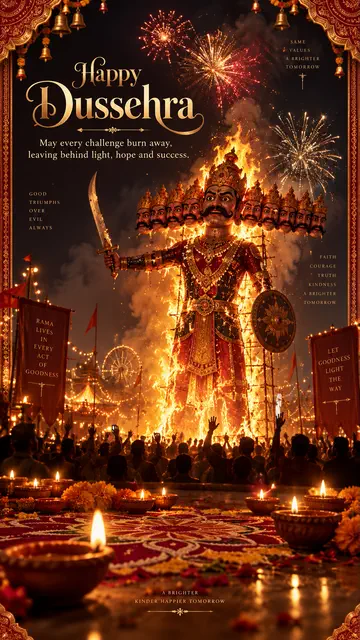
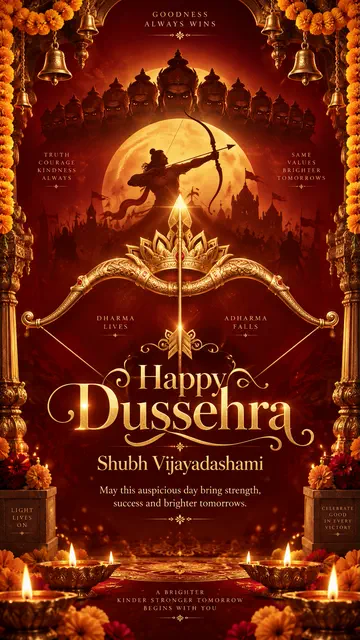
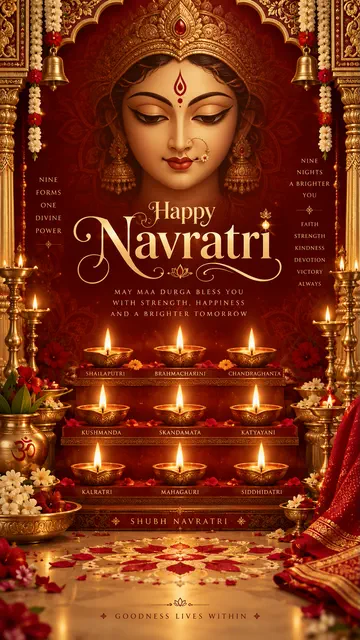
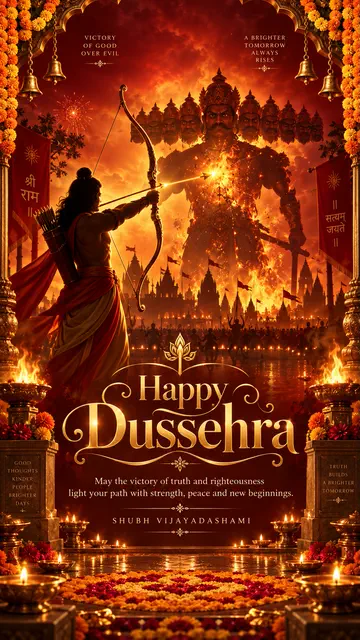
Download Free Poster, Images and Wallpapers for Navratri & Dussehra
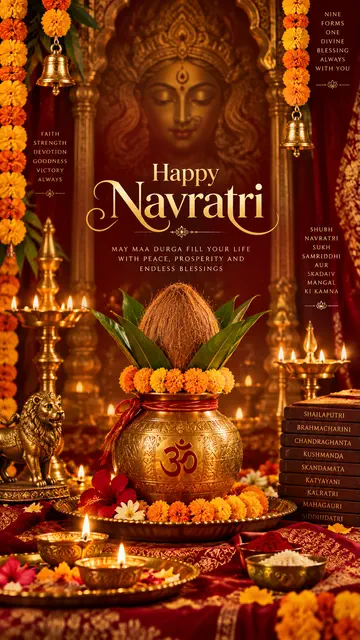
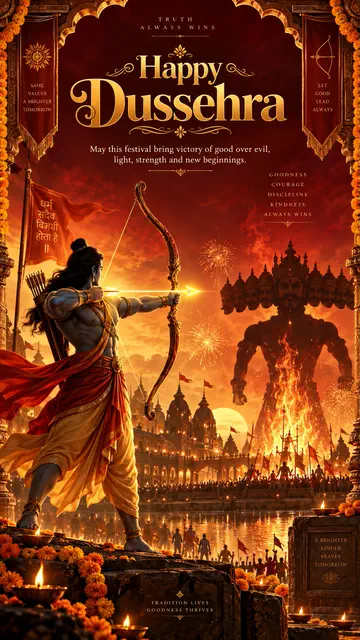
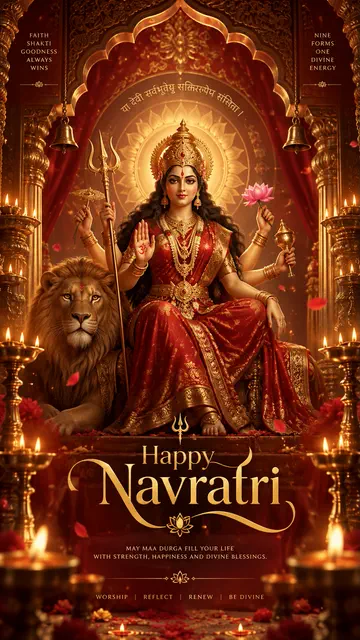
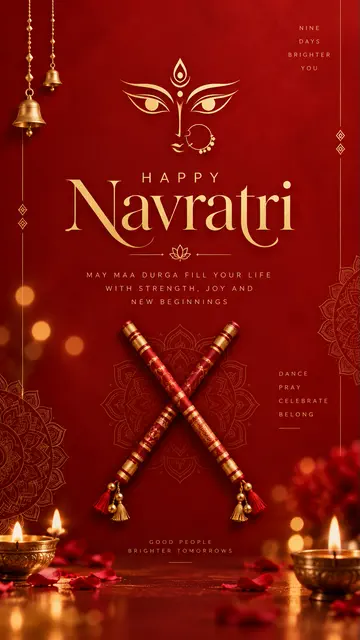
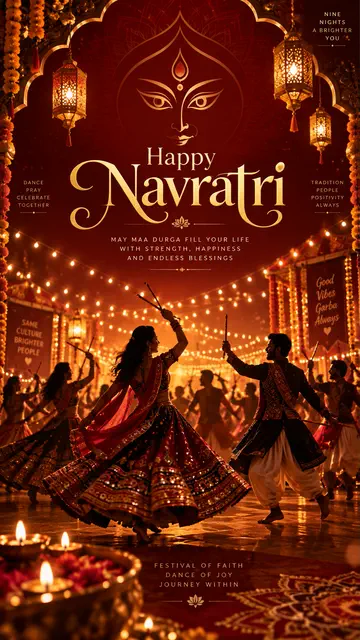
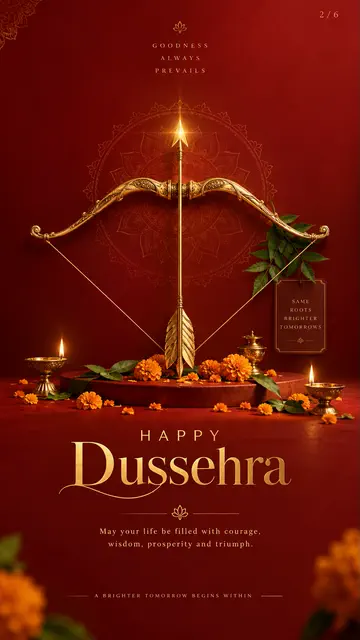
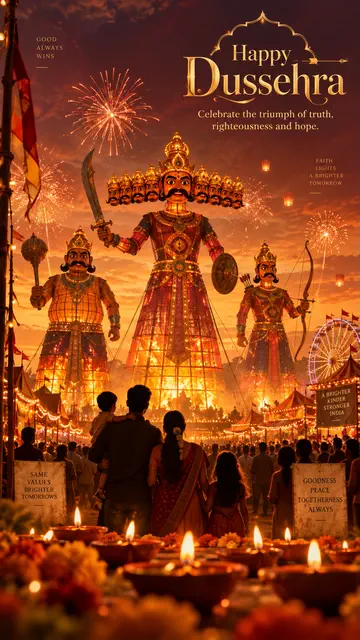
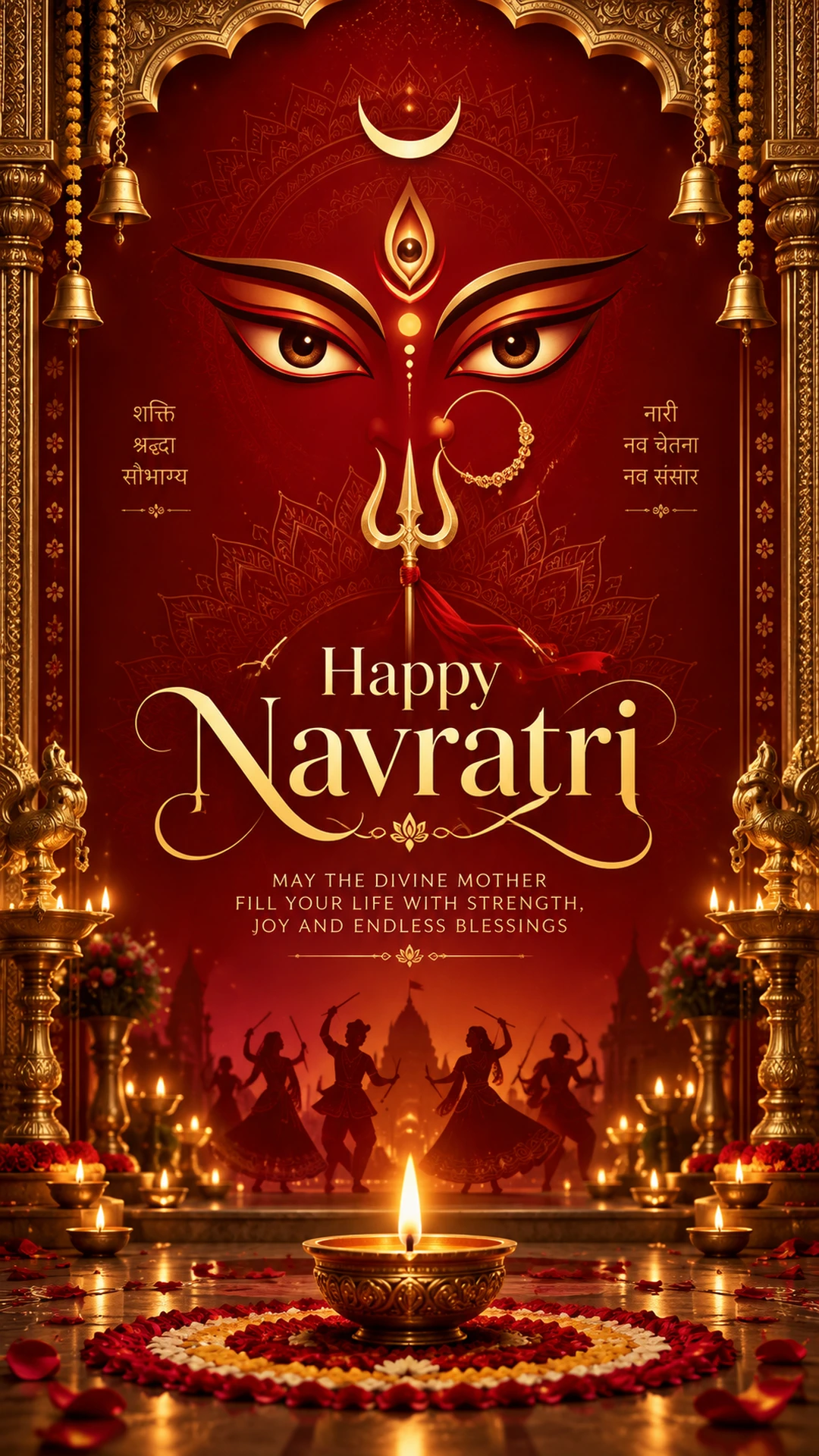
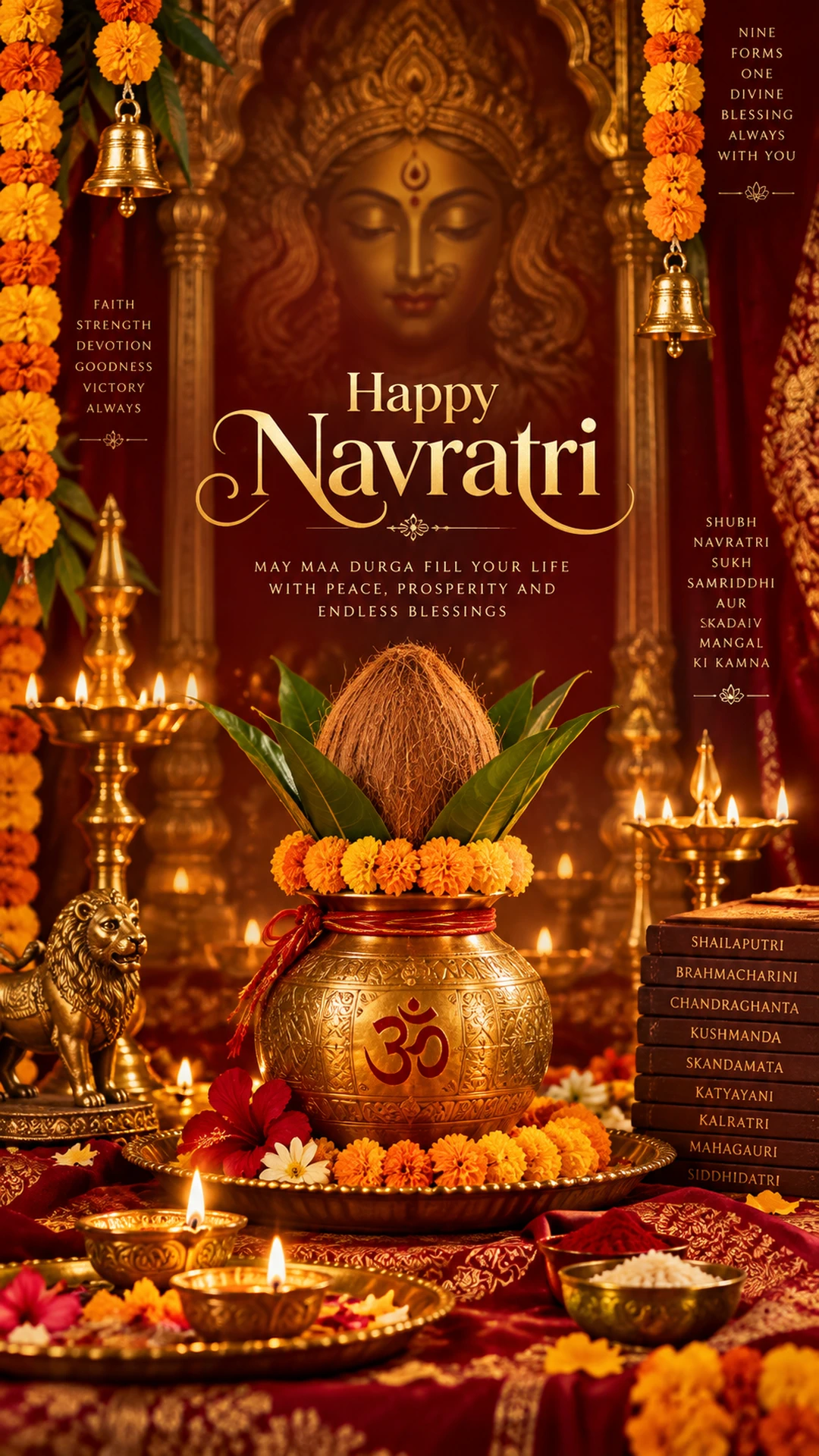
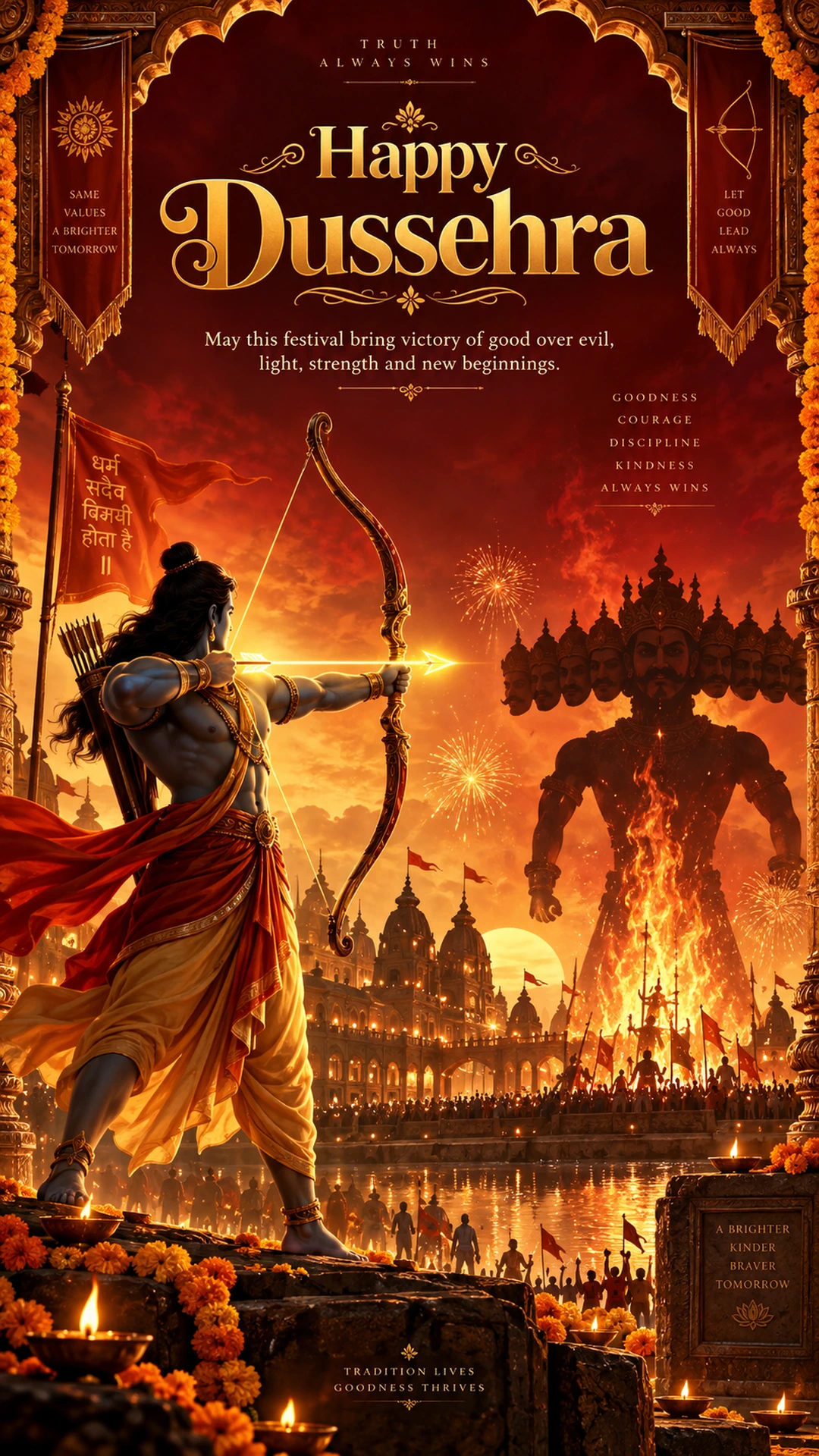
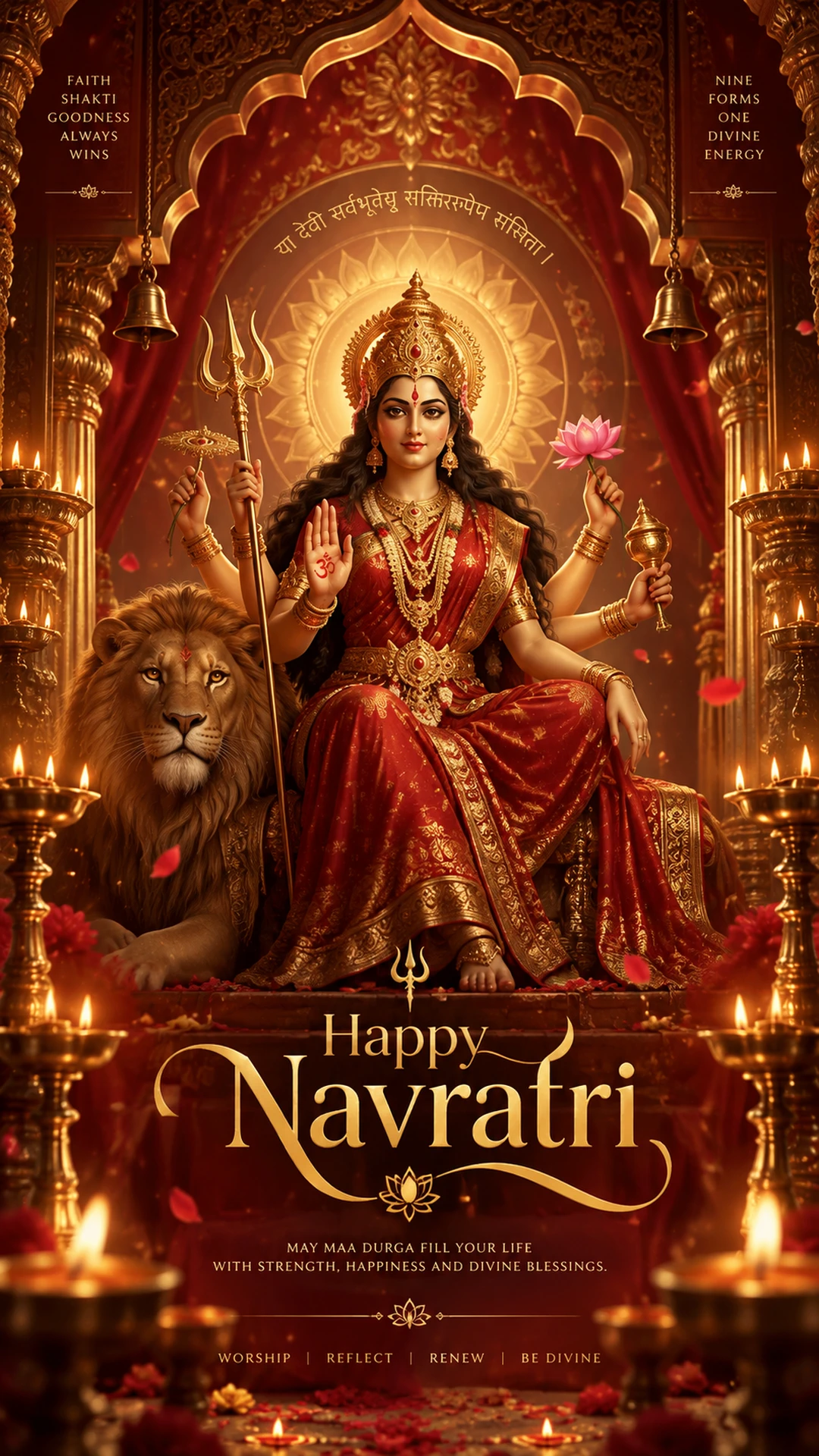
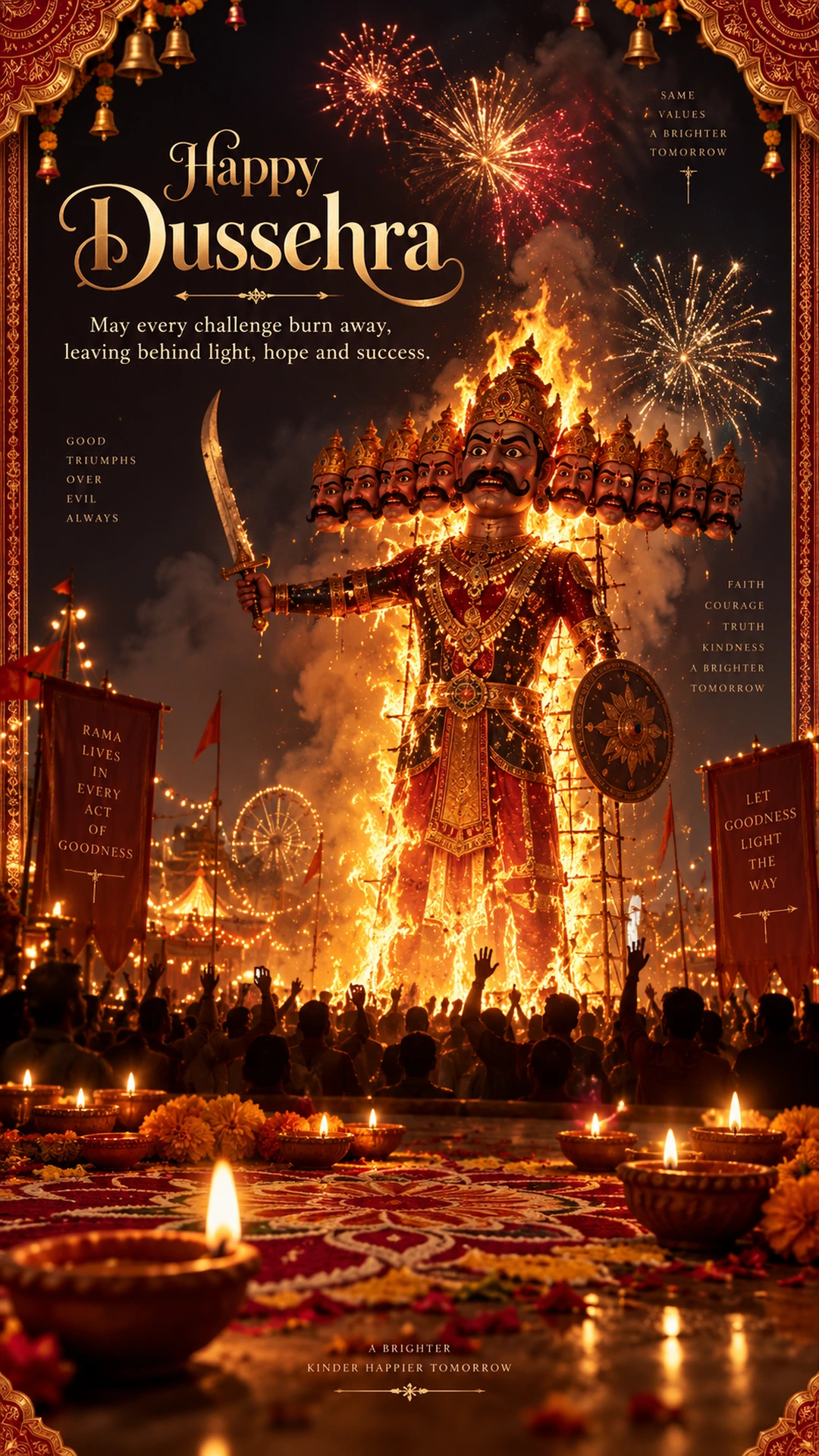
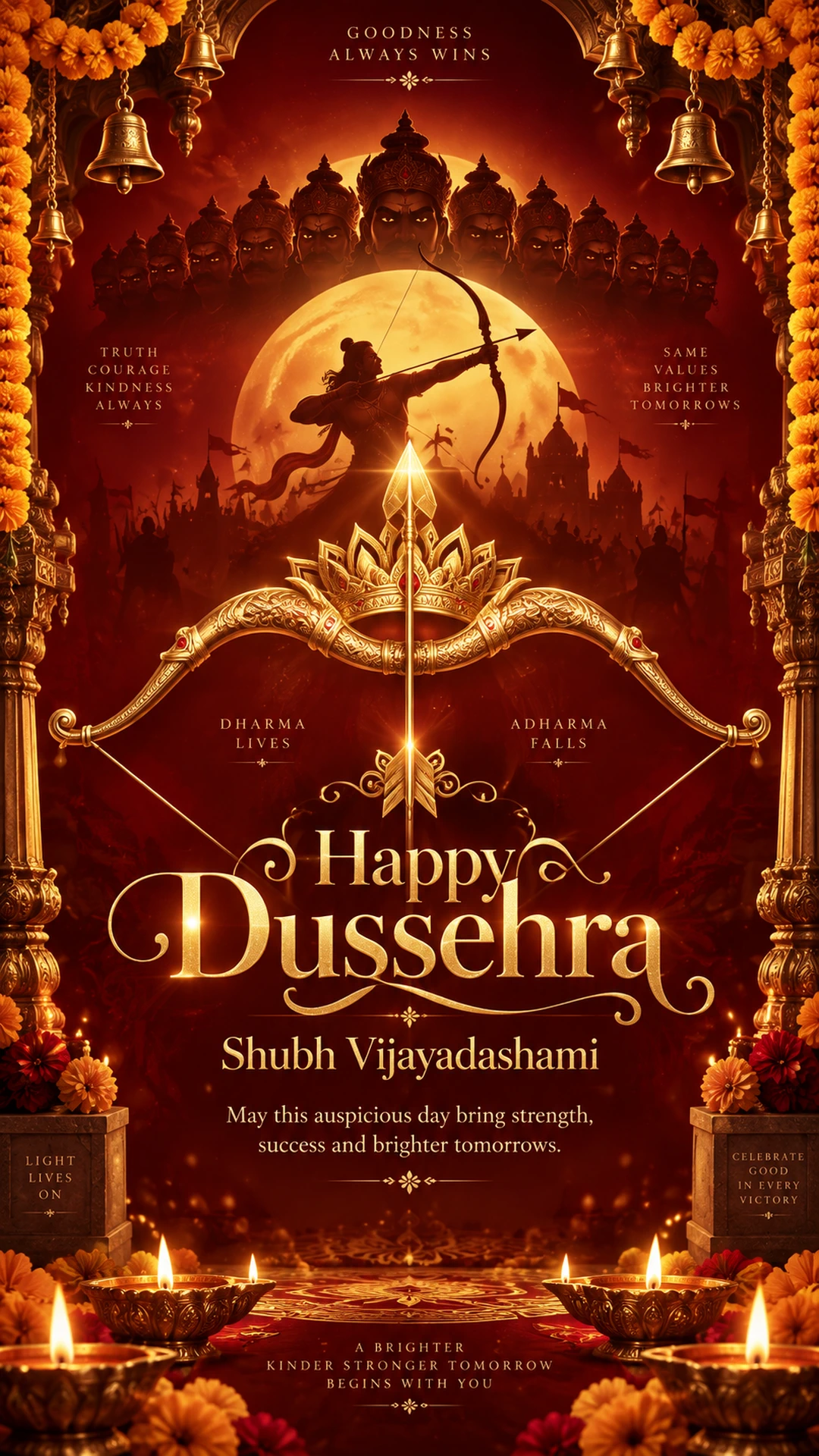
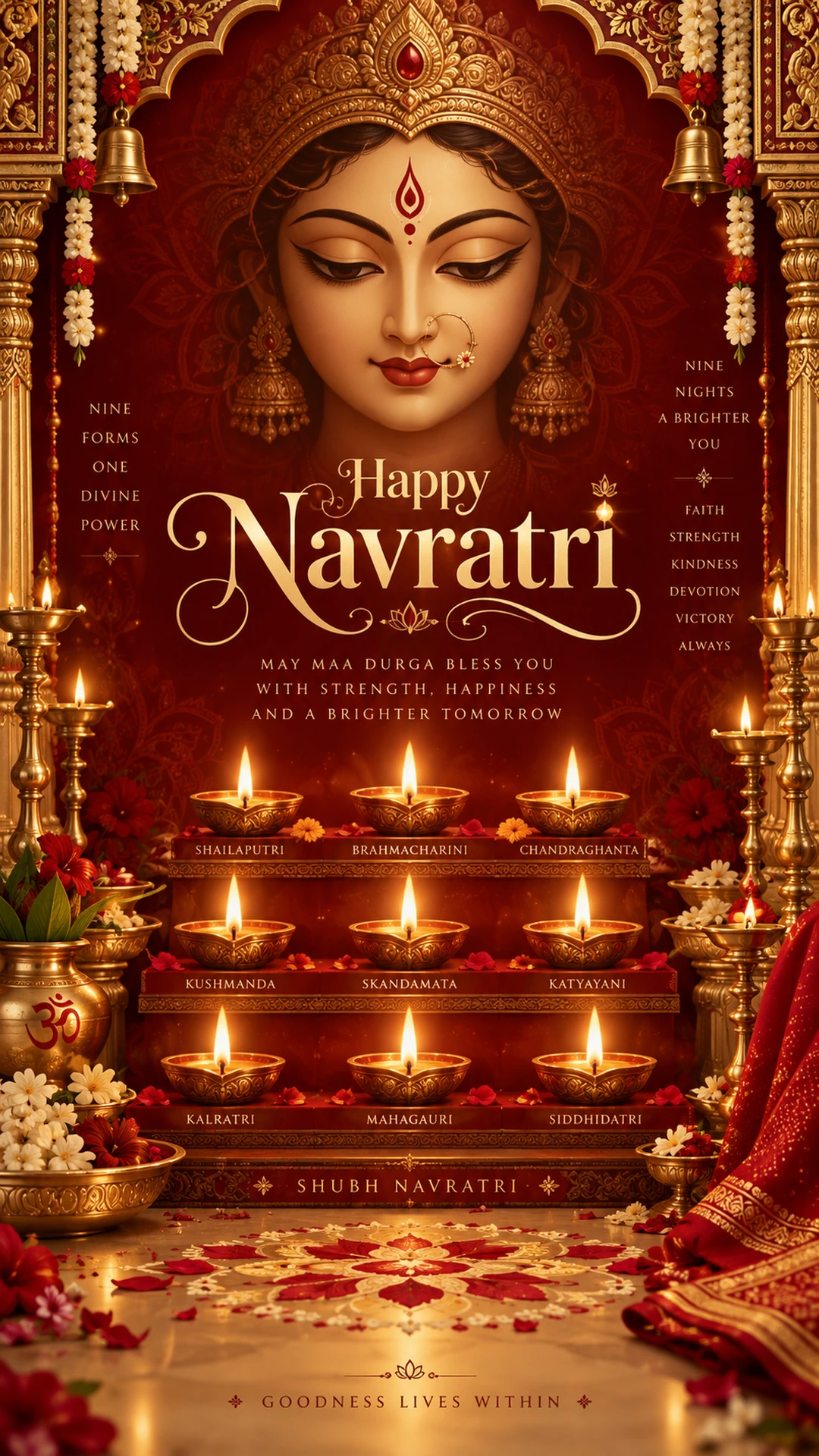
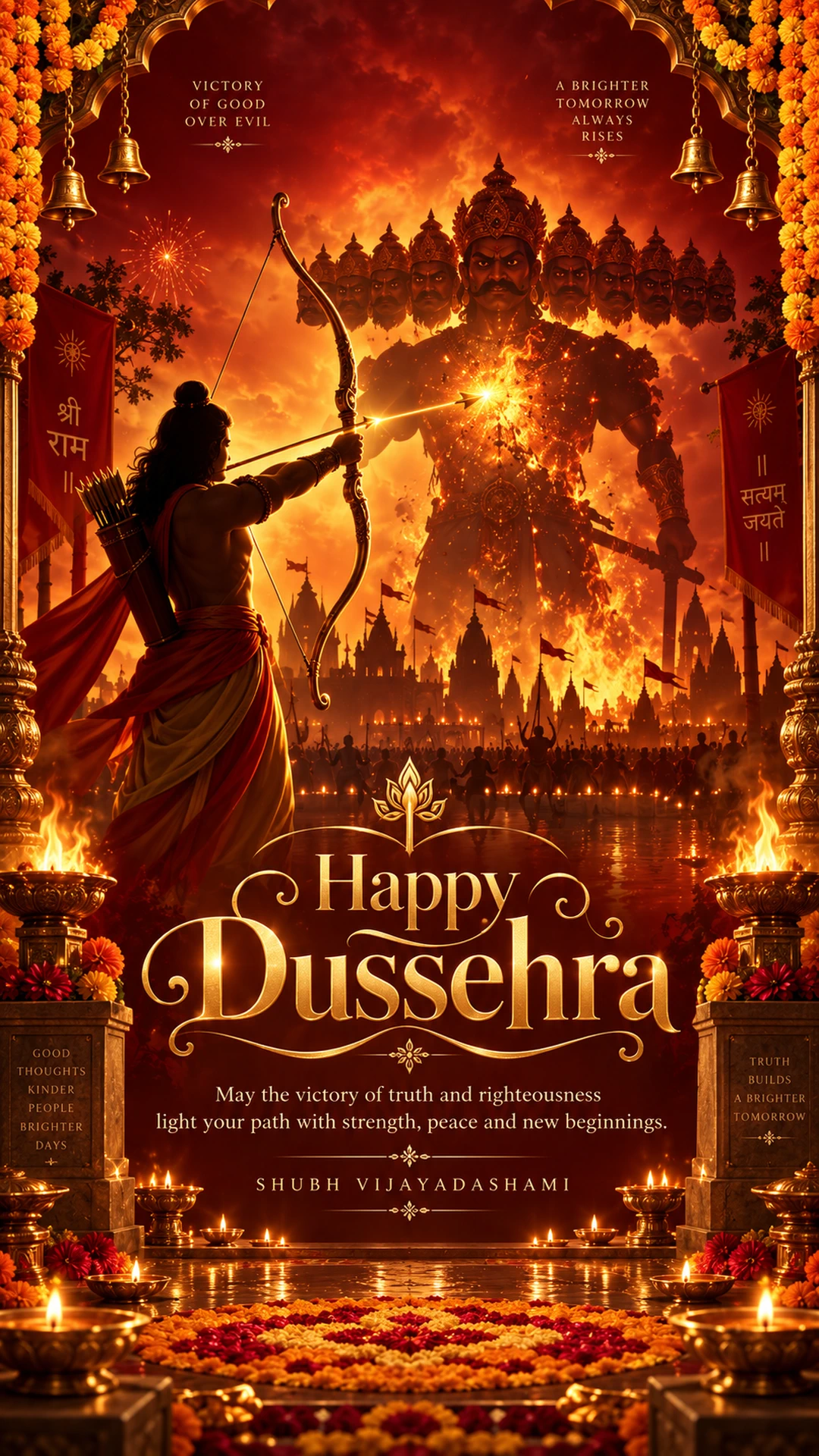
Free Story ImagesDownload these Navratri & Dussehra posters and images for WhatsApp Status, Instagram Stories or Facebook Stories.
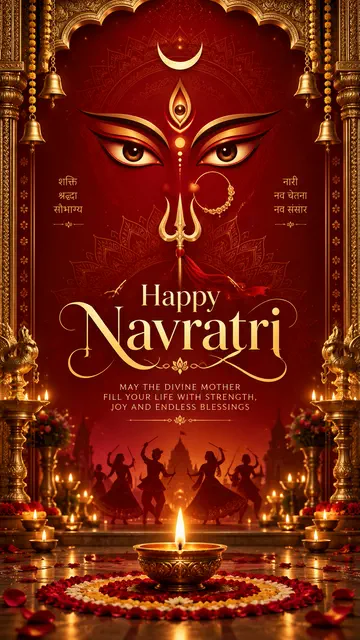
Sacred Durga eyes and glowing diyas — a devotional Happy Navratri story greeting.
Each download is supplied as a high-quality 1080 × 1920 WebP image, ready for WhatsApp, Instagram, Facebook and other social platforms.
Frequently Asked Questions
When is Navratri 2026, and when does Dussehra fall?+
Navratri 2026 runs for nine nights from 11 October to 19 October 2026, and Dussehra (Vijayadashami) falls the next day, on Tuesday, 20 October 2026.
What is the difference between Navratri and Dussehra?+
Navratri is a nine-night festival dedicated to worshipping the nine forms of Goddess Durga, focusing on devotion, dance, and fasting traditions. Dussehra, also called Vijayadashami, is the tenth day that follows immediately after and specifically celebrates Lord Rama's victory over the demon king Ravana, symbolising the triumph of good over evil.
Why is Navratri celebrated for nine days?+
The nine days correspond to the nine forms of Goddess Durga, known as the Navadurga, each honoured on a specific day for the distinct quality or strength it represents. Together, the nine days are seen as a journey of devotion moving from courage to wisdom.
What is Ravana Dahan?+
Ravana Dahan is the traditional burning of large effigies of the demon king Ravana, along with his brother Kumbhakarna and son Meghnad, performed on Dussehra evening. It is a public, community event symbolising the destruction of evil and the victory of righteousness, as told in the Ramayana.
What are the nine colours of Navratri?+
Many communities in India assign a specific colour to each of the nine days of Navratri, and devotees wear that colour to mark the day. The exact colour sequence can vary slightly by region and by year, so it's worth checking a current local calendar for the specific order used in 2026.
Is fasting compulsory during Navratri?+
No, fasting during Navratri is a personal and voluntary devotional practice, not a mandatory requirement. Many people observe partial or full fasts on specific days as an act of faith, while others participate in the festival fully through dance, prayer, and celebration without fasting at all.
What is the difference between Navratri and Durga Puja?+
Navratri and Durga Puja largely overlap in timing and both honour Goddess Durga, but they differ in regional style and emphasis. Navratri, as celebrated in states like Gujarat and much of North India, centres on nine days of dance (Garba/Dandiya) and daily goddess worship, while Durga Puja, prominent in West Bengal and eastern India, focuses on elaborately decorated pandals and grand idol installations concentrated mainly in the final four to five days.
Can non-Hindu students participate in or learn about Navratri and Dussehra?+
Yes, schools commonly present Navratri and Dussehra as an opportunity for all students, regardless of their personal faith, to learn about India's cultural heritage, mythology, and traditions. The focus in a school setting is typically educational and inclusive — understanding stories, symbolism, and customs — rather than requiring religious participation.
How do schools typically celebrate Navratri and Dussehra?+
Schools often organise a mix of cultural and educational activities such as Garba or Dandiya sessions, art and essay competitions, cultural assemblies, and classroom discussions on the festival's values. These activities are designed to build cultural awareness and community spirit among students of all backgrounds.
What is the significance of Kanya Pujan during Navratri?+
Kanya Pujan is a ritual, typically observed on Ashtami or Navami (the eighth or ninth day), in which young girls are worshipped as living representations of the Goddess. It reflects the festival's broader theme of honouring feminine strength and divinity.
Why do people perform Garba and Dandiya during Navratri?+
Garba and Dandiya are traditional folk dances performed during Navratri nights as a form of devotion and celebration, often danced in circles around a lamp or an idol of the Goddess. Beyond their religious roots, they have become widely popular community and social events that bring people together during the festive season.
Is Dussehra the same date every year?+
No, Dussehra's date changes each year because it follows the Hindu lunisolar calendar rather than the fixed Gregorian calendar. In 2026, it falls on 20 October, but the date shifts from year to year, generally occurring between late September and mid-October.
What is Vidyarambham and why is it associated with Vijayadashami?+
Vidyarambham is a ceremony, especially observed in South India, in which young children are formally introduced to reading and writing on Vijayadashami. The day is considered auspicious for new beginnings, making it a popular choice for initiating a child's educational journey.
How can I learn more about how Rainbow International School celebrates festivals like this with students?+
Rainbow International School, Thane brings festivals like Navratri and Dussehra into the classroom through cultural, creative, and values-based learning experiences for students. To see this approach firsthand, you're welcome to Schedule a Campus Visit or Enquire Now to speak with our admissions team.
Continue Exploring
Explore Rainbow Schools
Rainbow International School
CBSE-affiliated, Nursery to Grade 12 | Thane, Maharashtra
A modern, caring school where festivals become opportunities to connect culture, values, creativity and academic learning.
From ancient stories of wisdom to modern classrooms built for the future, Rainbow helps every child discover their potential.
Let courage light every new beginning.
Festivals like Navratri and Dussehra are more than a break from routine at Rainbow International School, Thane — they are woven into how we help students connect academic learning with culture, values, and community. Our campus, faculty, and everyday school life are shaped around helping every child discover their own potential, one celebration, one lesson, and one milestone at a time.
Jai Mata Di! Wishing every family at Rainbow International School a joyful Navratri and a victorious Dussehra 2026.
Families with a younger child at home may also enjoy our companion guide, Navratri & Dussehra 2026 for Kids, written for Rainbow International Pre-School's little learners.